
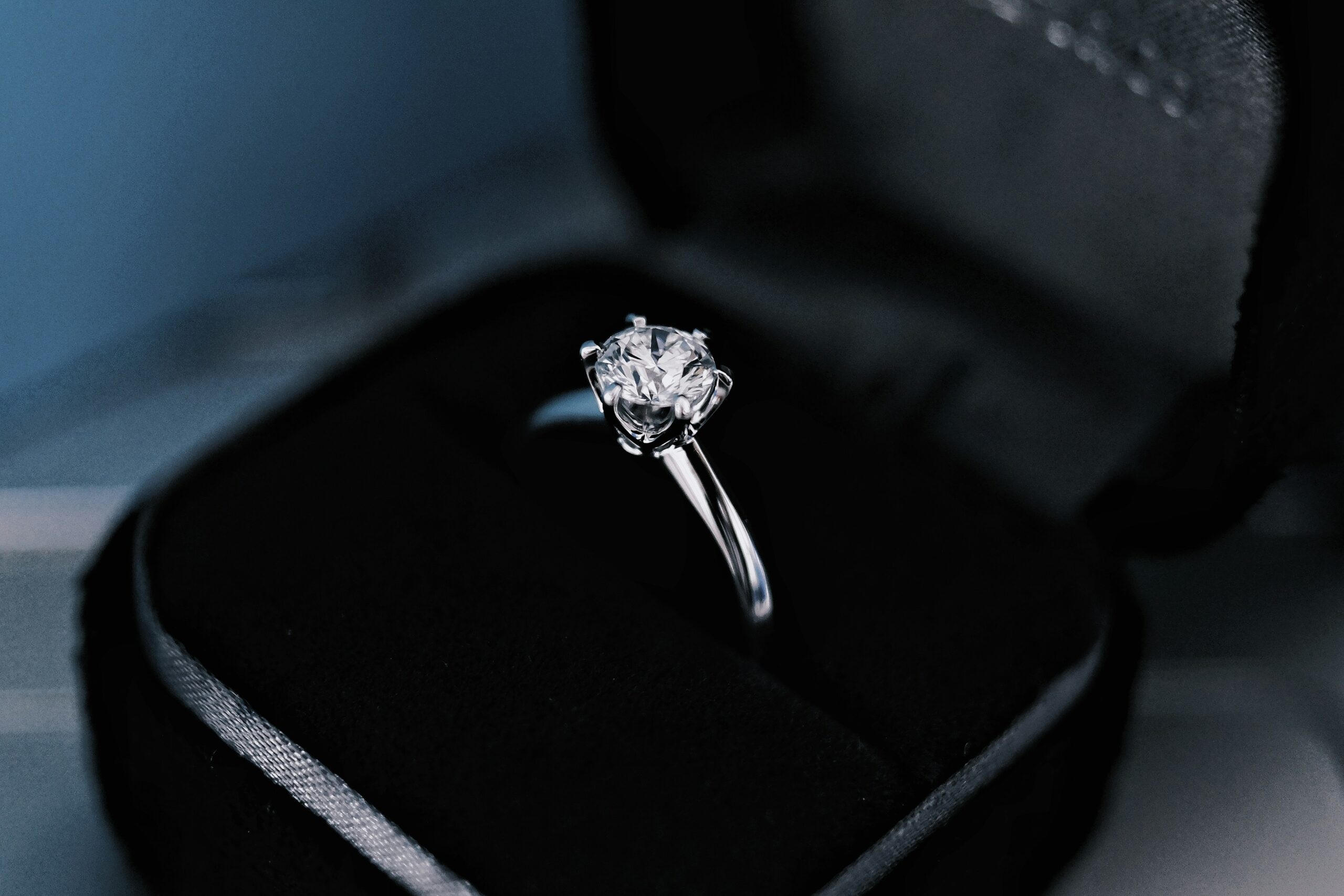
Every moissanite you can buy today was grown in a lab. That single fact makes the stones on sale far more alike than diamonds ever are. Where they do differ, it’s in places most shoppers never think to check: the exact shade of white, the way the stone was cut, and the metal holding it in place.
Which is good news, really. Especially if you’re buying online, or buying a ring that will spend most of its life near a kitchen sink, a laundry basket and the back seat of a car full of kids.
A quick detour first, because the name tends to raise questions. Moissanite takes its name from Henri Moissan, the French chemist who found tiny glittering crystals in fragments of the Canyon Diablo meteorite, from Meteor Crater in Arizona, in 1893 and, at first, believed he’d found diamonds. He hadn’t. They were silicon carbide, and natural crystals of it turned out to be so scarce that every gem you’ll see in a ring has been grown rather than mined. Moissan did fine without the diamonds, for what it’s worth. He won the 1906 Nobel Prize in Chemistry for an entirely different piece of work.
Color comes first
Start with color, because it’s the thing your eye catches before anything else. Moissanite runs from colorless down to near colorless, and how white a stone looks has more to do with its price than almost anything else about it. A good colorless stone today can sit next to a D to F diamond and hold its own. Near colorless? Think G to I.
That wasn’t always the case. The early “classic” moissanite had a yellowish, sometimes brownish look that people noticed, and you’ll still come across the occasional stone that turns faintly warm, or a bit gray, once you tilt it.
So how do you check? Grab a sheet of printer paper and stand by a window. Lay the ring on the paper and look straight down at it first. Then turn it on its side, because that’s where a tint stops hiding. Gem graders have a soft spot for north light for much the same reason (in the northern hemisphere it’s the steadiest, coolest daylight you’ll get, with none of the yellow of a late-afternoon sun or a kitchen bulb).
Small tip: be a little wary of listings that say “high color” and leave it there. The sellers worth buying from tell you the color range of the actual stone.
Then it’s shape. The quality moissanite engagement rings at Best Brilliance come in twelve cuts, everything from round and oval to square, elongated cushion and radiant, and you can have them as a solitaire, a halo, a hidden halo or a three-stone ring. Setting and stone are priced together, which means the number you see on the page is the finished ring. Handy when you’re trying to stick to a budget.
Cut, fire and the doubling effect
Cut is what turns a clear stone into a sparkly one, and moissanite starts with an unfair head start. GIA’s guide to gems that resemble diamond puts its fire at more than twice diamond’s, with slightly more brilliance on top. Fire, if nobody’s ever explained it to you, is those little bursts of rainbow color. It’s the bit your aunt spots from across the room at the engagement party.
Doubling is the odd one. Moissanite is doubly refractive: light goes in and splits in two. Put a jeweler’s loupe on it and the facets at the back can look doubled up, a bit like a photo taken while the camera moved. GIA lists this as one of the ways to tell moissanite apart from diamond.
Ever put a chunk of clear calcite on a newspaper? Same trick. Two of every letter, only far milder in a ring.
You’ll see more or less of it depending on the angle and the cut, so ask for a close-up video. Photos on their own won’t show you much.
And then there’s size. Somewhere past a carat, the fire gets intense. Some people love that. Others find it a touch disco ball for a Tuesday at the office, and if that’s you, stay under a carat and the sparkle stays in proportion.
Clarity and what a certificate tells you
Clarity is the easy part, for once. Moissanite is grown under controlled conditions, so it’s nearly always clean to the naked eye. There can be tiny inclusions, sure, but you’d need magnification to find most of them. That’s why clarity just doesn’t carry the weight here that it does with diamonds.
A bit of trivia while we’re on the subject. Silicon carbide was first made on purpose in 1891 by Edward Acheson, who was trying to make artificial diamonds and got something else entirely. He sold it as an abrasive called carborundum. It still grinds things down in workshops, and lately it’s ended up in the power electronics of a lot of electric cars. Same compound as the stone in your ring, just grown far more slowly and patiently.
About certificates. Lots of rings come with one, or with a little card. It describes the stone; it doesn’t vouch for the seller. Check that it actually says moissanite, that it gives the size and color range, and that it matches the ring that’ll turn up at your door. To be blunt, a decent return window and a warranty on the setting tell you more about whether a seller trusts their own product.
The setting and the metal
Now look at the prongs. Really zoom in. They should be even, rounded on top and snug against the stone, not leaning or gappy. Four prongs means you see more of the stone. Six means it’s held tighter. A bezel goes all the way round the edge, which is about as protected as a stone gets.
Metal is partly taste and partly how hard you are on your hands. 14K gold is roughly 58% gold and 18K is 75%, and that extra alloy in 14K makes it a little tougher against everyday knocks. Platinum’s heavier than both, and the most durable. With a colorless stone, go for white gold or platinum prongs even on a yellow or rose band. It keeps the stone looking white.
Something nobody tells you about white gold: most of it is rhodium-plated to get that bright, cold white, and over the years the plating wears down. A jeweler can redo it easily enough. So if your white gold ring starts looking a little warm after a few years, nothing’s wrong with it. It just needs replating.
Wearing it every day
On the Mohs scale, moissanite sits at 9.25. Diamond is a 10. Close, right? Not as close as it looks. Friedrich Mohs drew up his scale in 1812 by ranking minerals on which one scratches which, so the numbers aren’t evenly spaced. The more useful fact comes from the International Gem Society’s moissanite and diamond comparison: moissanite has no cleavage plane, so it’s very resistant to chipping. If your ring does the dishes, the weeding and bath time, that matters a lot.
Grease is what actually dulls it. Cook a few dinners, rub in some hand cream, put on sunscreen, and a film builds up on the back of the stone until the sparkle just drops off. Warm water and a drop of dish soap sort it out. Run a soft toothbrush under the setting, rinse, and you’re done in a few minutes. Take it off before you knead dough or clean with bleach, though. The setting stays cleaner, and you won’t be picking dough out of the prongs afterwards.
H2 – A quick quality checklist
| What to check | What good looks like | What to ask the seller |
| Color | Looks white in daylight, face up and from the side | The color range of this specific stone |
| Cut | Even sparkle across the stone, no dark patches | A close-up video in natural light |
| Doubling | Visible only up close, not a blurry center | Footage taken at an angle |
| Clarity | Clean to the naked eye | Whether any inclusion is visible |
| Setting | Even, snug, rounded prongs | Prong count and metal of the head |
| Paperwork | Names the stone as moissanite, states size and color | Return window and setting warranty |
Final thoughts
Engagement rings and diamonds have kept close company for a long time, at least since Archduke Maximilian of Austria gave Mary of Burgundy a diamond ring in 1477, and the pairing got a serious push in 1947 from the advertising line “A Diamond Is Forever.” Moissanite has a far shorter history in jewelry, but it does have one practical edge. You can check a moissanite ring from home with daylight, a video and a few direct questions, which is rarely true of a diamond.
From here, decide on shape and size together, since a bigger stone shows more fire. Then ask for footage of the exact ring you’d receive before you place the order.
FAQ
Will a diamond tester mistake moissanite for a diamond?
Quite often, yes, and it catches people out. Most basic testers work on heat: they check how fast the stone pulls warmth away from the tip. Moissanite happens to be very good at moving heat (it’s one reason silicon carbide ends up in electronics), so a simple thermal tester can’t really tell the two apart. A jeweler will use a proper moissanite tester instead. Or they’ll just look for those doubled facets under a loupe.
Is moissanite the same as a lab grown diamond?
No, though the two get mixed up all the time. A lab grown diamond is a diamond. It’s carbon, same as one dug out of the ground, only made in a lab. Moissanite is something else: silicon carbide. Its hardness is different, and it has more fire, too.
Does moissanite get cloudy over time?
Not the stone, no. Moissanite doesn’t change with age. If yours looks foggy, it’s almost certainly hand cream, soap or kitchen grease sitting on the back of it. Give it a proper clean and the sparkle comes straight back.
I have worked in collaboration with one of our partners to provide you with this post.

Leave a Reply